Biological Imaging in the GIDE Stack
foundingGIDE has established the foundational interoperability layers required to connect independent, globally distributed bioimaging repositories.
Through harmonised metadata and a shared set of recommended ontologies, foundingGIDE enables researchers to search across heterogeneous image data repositories (BioImage Archive, Image Data Resource and SSBD) using a single search tool.

The interoperability standards established by foundingGIDE is enabled through harmonised metadata and recommended ontologies mapped into a GIDE RO-Crate profile and harvested into a joint metadata snapshot that powers the GIDE Search Portal and API, allowing users to query the entire ecosystem through a single interface.
Use the table of contents below to navigate through the core components of this page:
- The use of RO-Crate in the Biological Imaging GIDE Stack
- Bioimaging Metadata
- Bioimaging Ontologies
- Returning FBbi to active maintenance
- The path from internal metadata to the cross-resource search portal
- Core Technical Deliverables for Biological Imaging
These interoperability standards have been fully implemented in the export pipelines of four major image data repositories: BioImage Archive (BIA), Image Data Resource (IDR), SSBD:database & SSBD:repository
The use of RO-Crate in the Biological Imaging GIDE Stack
RO-Crate is a community standard for packaging research data and its associated metadata in a structured form, built on JSON-LD and grounded primarily in schema.org. RO-Crate brings several additional properties that prove useful in the foundingGIDE context.
RO-Crate uses JSON-LD as its serialisation format, which makes every conformant document simultaneously valid JSON (consumable by any general-purpose tooling) and a true RDF graph. RO-Crate is an actively maintained community standard with stable tooling in multiple programming languages, a published specification process, and adoption across a range of research infrastructures and projects.
A RO-Crate profile is a layered specification that defines additional structural constraints on top of the base RO-Crate. A profile is the right level at which to express what foundingGIDE needs: not a new schema, not a new format, but an agreement among participating resources about which fields will be present, what semantics they will carry, and which vocabularies will be drawn on. The profile mechanism also allows a shared core between the image data resources which can be defined without forcing convergence on a monolithic schema.
The GIDE RO-Crate profile is a practical exchange contract rather than a new internal schema: each resource retains its own metadata model, while exposing study-level discovery metadata through a common RO-Crate profile, shared JSON-LD context and SHACL validation layer. The resulting profile captures the study-level components that are already common across BIA, IDR and SSBD. Version 1.2 of the RO-Crate specification introduced the detached RO-Crate construct, in which the ro-crate-metadata.json file stands alone with no associated payload. The construct is purpose-built for the case in which metadata is exchanged but data remains at its publishing resource. Each resource exports its catalogue as a set of detached RO-Crates, one per study; downstream consumers can build a shared index or shared graph.
The GIDE RO-Crate profile is study-level by design.
Bioimaging Metadata
The project established the GIDE RO-Crate profile as the technical contract for data exchange. This profile utilises a detached metadata approach, meaning that lightweight metadata is shared and indexed while the heavy image files remain with the authoritative original repositories. The profile is published at https://www.gide-project.org/ro-crate/search/1.0/profile and the human-readable specification and JSON-LD context are maintained in https://github.com/foundingGIDE/gide-search.
The GIDE RO-Crate profile uses two tiers:
- a mandatory tier of nine properties for basic search: id, name, description, datePublished, license, author, publisher, about, measurementMethod
- an extended tier of six properties for richer details: identifier, keywords, thumbnailUrl, seeAlso, funder, size
| Metadata component | Vocabulary | Hierarchy | RO-Crate Profile field | Tier |
| Study identifier | – | Study | Dataset @id (resolvable URL) and Dataset identifier | Core (MUST) |
Authors | ORCID for Person @id; ROR for Organisation @id | Study | Dataset author → Person and/or Organisation | Core (MUST) |
Publication | DOI preferred for @id DOI (as ScholarlyArticle) | Study | Dataset seeAlso → ScholarlyArticle | Extended (optional) |
License | URL to a licence description | Study | Dataset license | Core (MUST) |
Release date | ISO 8601 | Study | Dataset datePublished | Core (MUST) |
Imaging method | FBbi for the DefinedTerm @id (SHOULD) | Study Component | Dataset measurementMethod → DefinedTerm and/or LabProtocol | Core (MUST exist; SHOULD use FBbi) |
Organism | NCBI Taxonomy for the Taxon @id (SHOULD) | varies (Study at IDR; Study Component at BIA, SSBD) | Dataset about → Taxon (and/or BioSample taxonomicRange → Taxon) | Core (MUST exist; SHOULD use NCBITaxon) |
Channel — content | – | Image data | Not captured at study level | Not in scope for study level exchange |
Channel — biological entity | – | Image data | Not captured at study level | Not in scope for study level exchange |
Data identifier (image-level) | – | Image data | Not captured at study level | Not in scope for study level exchange |
Dimension | – | Image data | Not captured at study level | Not in scope for study level exchange |
Pixel/voxel size | – | Image data | Not captured at study level | Not in scope for study level exchange |
Mapping metadata components onto the GIDE RO-Crate profile
Bioimaging Ontologies
To ensure that metadata is machine-readable and consistent across borders, the biological imaging stream relies on a curated set of community-governed ontologies.
| Suggested column | What it records | Recommended vocabulary/ontology |
| Imaging Method | The technique used to acquire the image | FBbi |
| Organism | Species of the imaged sample | NCBITaxon |
| Cell Line | The cell line imaged | CLO (Cellosaurus RRID:CVCL_) |
| Cell Type | The cell type, where not a named line | CL (Cell Ontology) |
| Gene | Gene under study or perturbed | Ensembl gene |
| Protein | Protein associated with the file or channel | UniProt (EFO for broader entities) |
| Compound | Chemical or drug applied | ChEBI (PubChem) |
| Antibody | Antibody reagent used | RRID (antibody) |
| Channel – Content | What a channel reports (label, stain, fluorophore) | FBbi |
| Channel – Biological Entity | The biological entity a channel marks | UniProt (EFO) |
| Pathology / Disease | Disease or pathological state | MONDO (DOID, ICD-11; SNOMED CT) |
| Phenotype | Observed phenotype | CMPO (MP, HPO) |
| Organ / Anatomy | Anatomical structure or organ | UBERON |
| Experimental Condition | Experimental factor or assay condition | EFO (OBI) |
| Units (e.g. Concentration, Time) | Unit of a numeric column | UO |
Returning FBbi to active maintenance
The Biological Imaging Methods Ontology is now maintained, from 2026 onwards, as a joint community effort under the umbrella of the FoundingGIDE project, with primary maintenance carried out by German BioImaging. The source files are held in a public repository at
https://github.com/foundingGIDE/fbbi, under a CC-BY-4.0 licence, and the ontology continues to be served through the established OBO Foundry channels: the stable release is available at the persistent identifier http://purl.obolibrary.org/obo/fbbi.owl, and terms can be browsed in the EBI Ontology Lookup Service. Maintaining continuity of these identifiers and access points was a deliberate choice, so that existing users of FBbi see no disruption as maintenance resumes.
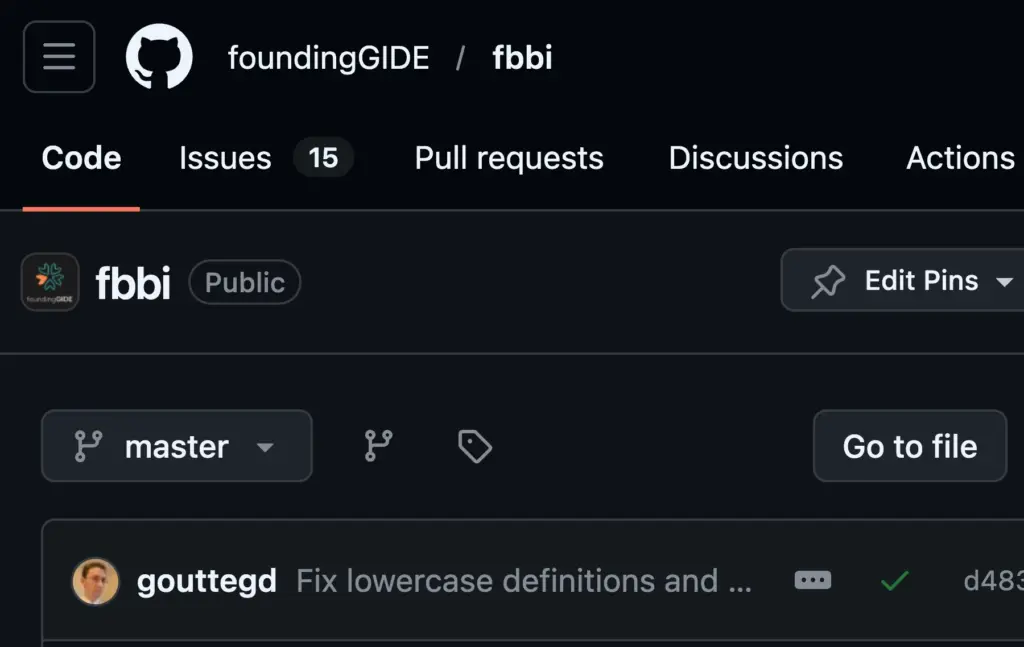
The repository is built using the Ontology Development Kit, the standard tooling for OBO ontologies, which provides a reproducible release process and brings FBbi into line with the practices of the wider ontology community. Term addition and revision are handled openly. New terms and corrections can be requested through the repository’s issue tracker. Requests may also be raised through the community’s usual channels, including the image.sc forum, lowering the barrier for imaging scientists who are not regular users of version-control tooling. A release was made on 30 March 2026, and the work of adding terms, both by the maintainers and through community contributions, is ongoing rather than complete; the issue tracker holds a number of open term requests at the time of writing.
The path from internal metadata to the cross-resource search portal
Each resource implemented an export pipeline that emits detached RO-Crates conformant with the profile, one per study. The crates use the shared JSON-LD context to ensure that term identifiers resolve identically across resources, and they reference ontology terms (in particular, NCBI Taxonomy entries for species and FBbi terms for imaging methods) as resolvable URIs rather than as opaque strings.
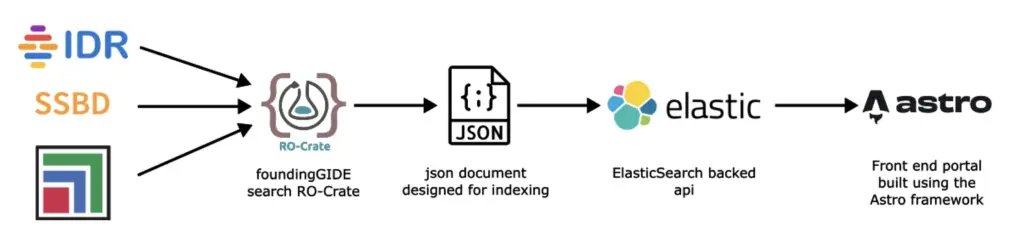
The strength of this flow is that it asks little of the participating resources beyond the export pipeline itself. There is no convergence on a shared internal schema, no shared operational database, no joint runtime dependency between resources. This enables easier onboarding of future data resources.
All three resources have implemented profile-conformant exporters, maintained at:
- https://github.com/BioImage-Archive/gide-ro-crate (BIA)
- https://github.com/German-BioImaging/idr_study_crates (IDR)
- https://github.com/openssbd/gide-ro-crate (SSBD)
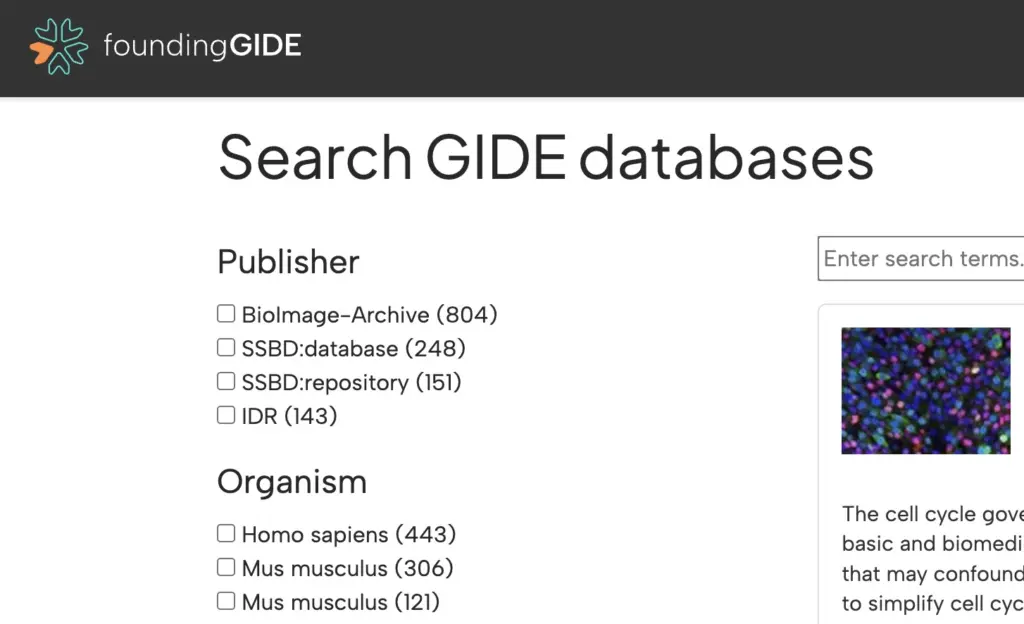
The metadata from these resources is harvested into a joint snapshot representing 1,584 validated studies. This snapshot powers the GIDE Search Portal and API, allowing users to query the entire ecosystem through a single interface.
Core Technical Deliverables for Biological Imaging
The foundingGIDE project has produced a comprehensive suite of technical and strategic documents that form the functional backbone of the Global Image Data Ecosystem (GIDE) for biological imaging. We highly encourage readers to explore these outputs to understand the standards, metadata schemas, and software architectures that enable GIDE.
| Deliverable | Description |
D6.1 — Report in metadata model overlap and gaps | This deliverable defines the metadata harmonization requirements across various data resources to enhance the interoperability of bioimaging data. To achieve this, we first compared the metadata models of the major bioimaging data resources – BioImage Archive (BIA), Image Data Resource (IDR), and SSBD:database – to identify overlaps and differences of metadata components, as well as to determine the metadata components and ontologies that should be harmonized. Next, we analyzed various use cases for bioimaging data reuse, identifying the necessary metadata components, suitable ontologies, controlled vocabularies, and relevant communities to clarify the requirements for metadata harmonization that would facilitate data reuse. Finally, we provided milestones for BIA, IDR, and SSBD to achieve metadata harmonization for global bioimaging data sharing. Additionally, we briefly explored metadata management and sharing methods to consider a more sustainable and flexible framework for bioimaging data integration. |
D2.1 – Landscape analysis of existing ontologies and recommendations on a set of imaging ontologies | This deliverable presents a comprehensive analysis of the current landscape of ontologies relevant to biological and preclinical imaging data. Here we identify and evaluate existing ontologies and integrate the findings into recommendations for supporting harmonized image data representation and enable interoperability of global image data resources. The recommendations from D2.1 will also serve as a guidance for data producers to adopt, in order to make their data easier to incorporate in open data repositories. |
| D5.1 – Updating existing ontologies, and implementing in data resources | The deliverable takes as its starting point the ontology set recommended in D2.1 (ontology landscaping and recommendations), and the per-component representation specified in D6.1. First it reports the return of the Biological Imaging Methods Ontology (FBbi) to active maintenance, now as a community effort under the FoundingGIDE project. New terms are being added using community-standard tooling, an open contribution process and continuity of its established identifiers. Second, it reports wider GIDE ontologies implementation in the participating resources. The BioImage Archive now uses FBbi identifiers internally within its RO-Crate-based metadata representation, and has published guidance enabling submitters to record ontology terms using its submission system. The corresponding implementation in SSBD, and guidance on future compatibility with the IDR, are reported in the respective sections. Preclinical imaging ontologies are addressed in D4.1 and are outside the scope of this deliverable. The longer-term sustainability of these maintenance arrangements is the subject of D5.2. |
| D5.2 – Maintenance plan for ontology sustainability | This deliverable takes as its starting point the ontology set recommended in D2.1, the harmonised representation specified in D6.1, and the implementation within resources reported in D5.1. It distinguishes two situations. The Biological Imaging Methods Ontology (FBbi) is the one element of the selected set specific to the bioimaging domain, and the one that required intervention during the project. It has now been returned to active, community-governed maintenance, and this deliverable describes ongoing arrangement for that maintenance. The remaining vocabularies are maintained by established external communities, and for these the plan describes a lighter model of monitoring and periodic review by GIDE resources of maintenance status. |
| D7.1 – Establish minimal shared interoperability metadata | This deliverable aimed to establish a core, shared set of metadata sufficient to enable cross-resource discovery and search across the participating bioimaging data resources (BioImage Archive (BIA), Image Data Resource (IDR) and SSBD) without requiring those resources to adopt a single shared schema. This deliverable describes the resulting specification: the foundingGIDE search input RO-Crate profile (v0.2, January 2026), which defines a minimal interoperability metadata set as a profile of the RO-Crate community standard, together with a companion JSON-LD context that defines profile’s terms in schema.org, Bioschemas, Darwin Core and OBO Foundry vocabularies. The profile is built directly on the twelve commonly-held metadata components identified in Deliverable D6.1, and adopts a two-tier structure: a small core of mandatory fields that drives cross-resource search, and an extended REMBI-aligned layer that supports richer expression for resource-specific metadata. |
D10.1 — Model description and snapshot | This deliverable presents the harmonized metadata for the foundingGIDE project, collecting study-level metadata of the major bioimaging data resources – BIA, IDR, and SSBD. The RO-Crate framework was chosen as the common base for the joint data model, for its large tooling ecosystem and compatibility with state-of-the-art semantic web standards. Building upon “Deliverable D6.1: Report in metadata model overlap and gaps”, we developed a specification of a detached RO-Crate 1.2 profile describing an extensible framework, balancing expressiveness and ease of use, detailed in D7.1. Metadata from the three repositories was converted into the common format by custom pipelines and validated programmatically; the process was repeated iteratively, improving the quality of both the original metadata sources and of this deliverable. |
D11.1 — Data portal and supporting API | This deliverable reports on the GIDE bioimaging search system, which provides a search interface, accessible via both a data portal and underlying Application Programming Interface (API), that allows search over hundreds of imaging datasets held in independent, globally distributed resources. The system comprises three connected components: a catalogue indexing pipeline that ingests harmonised metadata from the participating resources; an API that exposes search across the resulting index; and a reference web portal, built on that API, that presents cross-resource search to end users. All three are complete and publicly deployed, with the reference portal available at https://www.gide-project.org/portal and the API at https://www.gide-project.org/search/search. |