Preclinical Imaging in the GIDE Stack
Preclinical imaging encompasses a wide range of modalities, experimental models and study designs, resulting in highly heterogeneous datasets that can be difficult to describe, discover and reuse across research environments.
The Preclinical Imaging GIDE Stack addresses these challenges through establishing a harmonised metadata model, the PReclinical Imaging Standardized Metadata (PRISM) model, a set of preclinical ontologies and tool that integrate these developments with existing data management platforms.

Together, the PRISM metadata model and the preclinical ontologies provide complementary foundations for describing preclinical imaging data while the tools developed in this project enable these developments to integrate seamlessly with existing data management platforms.
Use the table of contents below to navigate through the core components of the Preclinical Imaging GIDE Stack
- Preclinical Metadata
- Preclinical Ontologies
- Preclinical Tools
- Core Technical Deliverables for Preclinical Imaging
Preclinical Metadata
PRISM (PReclinical Imaging Standardized Metadata) is a metadata model specifically designed for preclinical imaging datasets. Building on existing community-driven standards, in particular REMBI and the ARRIVE 2.0 guidelines, PRISM aims to define a comprehensive and interoperable metadata model capable of covering the entire lifecycle of preclinical imaging studies, from study design and experimental procedures to image acquisition, correlation and analysis. It extends these by adding approximately 200 metadata elements across eight major sections to capture highly specific information often missing from public records. The PRISM approximately 200 metadata organized into eight major sections are designed to comprehensively describe the entire lifecycle of preclinical imaging studies:
1. Study Design: Collects metadata describing the overall design and scientific context of the study. It includes information about the study type, background, objectives, and any associated publications.
2. Study Component: Records of technical and organizational details, utilizing Research Organization Registry (ROR) codes for institutions and ORCID identifiers for principal investigators. It also captures funding sources and data access conditions.
3. In Vivo Experimental Parameters (IVEP): Describes the experimental design and biological parameters. It includes information on study groups, sample size, randomization, blinding, outcome measures, and detailed animal characteristics.
4. Experimental Procedures: Documents for all interventions, including pharmacological treatments, surgical procedures, and anesthesia protocols. It specifically tracks cell lines, reagents, and specialized equipment used during the study.
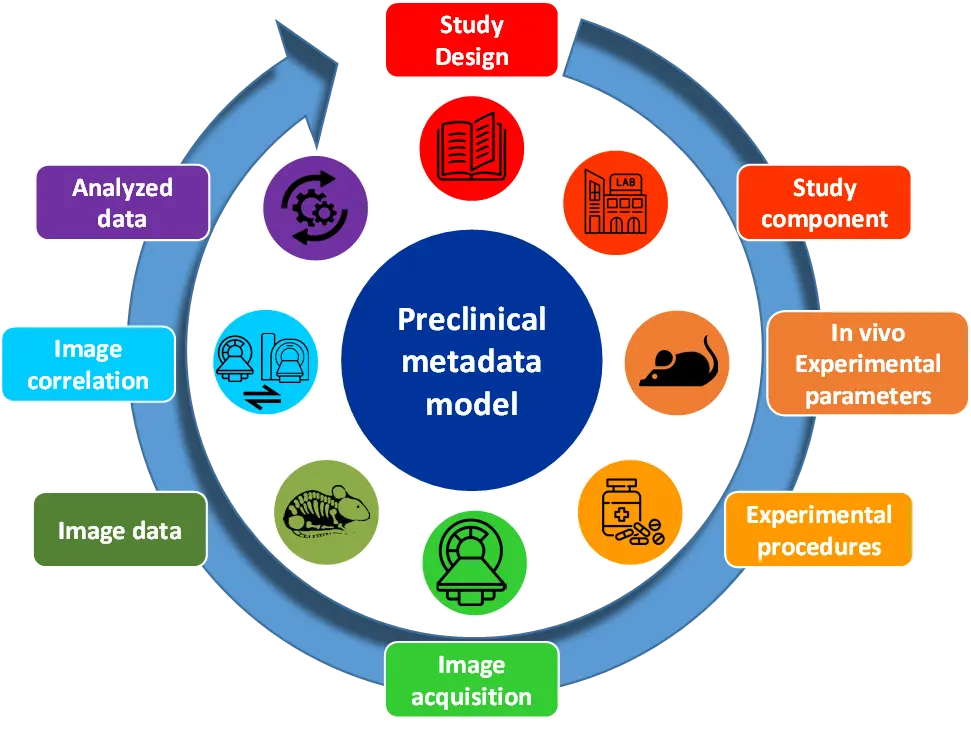
5. Image Acquisition: Describes the technical parameters associated with image acquisition for each imaging modality. This section includes modality-specific metadata for MRI, PET, SPECT, CT, OI, US, PAI, MPI, and EPRI. Metadata includes imaging instrumentation, acquisition parameters, applied corrections, raw data availability, and quality assurance/control procedures.
6. Image Data: Defines the characteristics of the image dataset. It includes file formats, dimensions, spatial resolution, reconstruction algorithms, applied corrections, processing steps, and AI-based enhancements if applicable.
7. Image Correlation: Describes how images from different modalities or datasets are spatially and temporally correlated. It includes alignment methods, transformation matrices, fiducial markers, and relationships between related datasets.
8. Analyzed Data: Documents the results derived from image analysis. It includes the type of analysis performed, the data and features used, the analysis methods and software, and the format of the output files.
Deliverable 8.1 Recommended harmonised metadata model for preclinical image datasets provides a detailed explanation of this work.
Preclinical Ontologies
The GIDE stack recommends a curated set of ontologies to cover the multidisciplinary domains of preclinical imaging.
First step in establishing the set of recommended preclinical ontologies was the identification of relevant domains associated with preclinical imaging. 14 domains were identified to cover the multiple disciplines of preclinical imaging datasets and 35 ontologies were selected to cover all the domains, with at least two ontologies for each domain. Since more than one ontology was identified that could be associated to each domain, a scoring criteria was established for the selection of the ontology that should be recommended for a specific domain.
The selected ontologies provide a standardised way of representing the knowledge contained in preclinical image datasets, facilitating machine understanding and processing of the information within each domain.
| Domain | Ontology recommended | |
| 1 | Disease | DOID |
| 2 | Drugs | ChEBI |
| 3 | Anatomy | UBERON |
| 4 | Cell line | CL |
| 5 | Genomic | GO |
| 6 | Imaging | DICOM |
| 7 | Strain | EFO |
| 8 | Experimental conditions | OBI |
| 9 | Biomedical and biological resource | CMO |
| 10 | Pathology | MPATH |
| 11 | Analysis | SWO |
| 12 | Radiology | RADLEX |
| 13 | Phenotype | MP |
| 14 | Access / Usage | DUO |
A detailed description of the identification of domains and associated ontologies, as well as on the evaluation of the identified ontologies is provided in deliverable D2.1 Landscape analysis of existing ontologies and recommendations on a set of imaging ontologies and D4.1 Report on the recommended ontologies for preclinical image datasets and technologies.
Preclinical Tools
The preclinical tools include the PIDAR platform, XNAT plugins for entering PRISM metadata, and a Python-based workflow for the automated extraction of ontology codes. More on this work can be found in the foundingGIDE Deliverable D12.1
Core Technical Deliverables for Preclinical Imaging
These deliverables represent a transition from theoretical landscape analyses to practical, operational tools that are now bridging independent preclinical image data repositories. These resources provide the necessary technical blueprints for achieving FAIR for preclinical imaging data. We highly encourage readers to explore these outputs, including the PRISM model, curated preclinical ontologies, and XNAT integration tools, to understand the standards, metadata schemas, and software architectures that enable GIDE.
| Deliverable | Description |
| D2.1 Landscape analysis of existing ontologies and recommendations on a set of imaging ontologies | This deliverable presents a comprehensive analysis of the current landscape of ontologies relevant to biological and preclinical imaging data. Here we identify and evaluate existing ontologies and integrate the findings into recommendations for supporting harmonized image data representation and enable interoperability of global image data resources. The recommendations from D2.1 will also serve as a guidance for data producers to adopt, in order to make their data easier to incorporate in open data repositories. |
| D4.1 Report on the recommended ontologies for preclinical image datasets and technologies | Preclinical imaging has emerged over the past two decades as a rapidly expanding field, playing a fundamental role in both basic research and the development of new therapies. The advent of new imaging modalities and increasingly sensitive and specific probes allow us to obtain in vivo information at the anatomical, molecular and functional levels. This exponential increase in the ability to generate image datasets has not gone hand in hand with the ability to make these datasets findable and reusable. One of the main limitations is related to the lack of a set of ontologies large enough to cover the multidisciplinarity of preclinical imaging. The aim of this deliverable is to identify the different domains in which preclinical images fall, to search and evaluate the different ontologies that can cover each of the various domains and to select the more useful ontologies based on a series of criteria. The final objective is to provide a set of recommended ontologies for improving the findability of preclinical image datasets. |
| D8.1 Recommended harmonised metadata model for preclinical image datasets | The use of diverse imaging technologies in preclinical imaging research generates large volumes of heterogeneous data. Currently, the absence of standardized and structured metadata often limits the discoverability, accessibility, interoperability, and reusability of these datasets within the scientific community. The objective of this deliverable is to define a common metadata model for preclinical imaging datasets that meets the needs of preclinical imaging centers while supporting FAIR data management principles. To achieve this goal, the PRISM (PReclinical Imaging Standardized Metadata) model was developed with the involvement of international experts in preclinical imaging. The implementation of the PRISM model will improve the discoverability, interoperability, accessibility, reproducibility, and reusability of datasets across preclinical imaging infrastructures and repositories. |
| D12.1 Tools for ontology and metadata management, and metadata interoperability | Image data is one of the fastest growing types of research data, characterized by rapid advances in imaging technologies and workflows of increasing complexity. This growth places significant pressure on the research community to establish and maintain consistent metadata standards — a task that is technically demanding and requires sustained policy coordination across institutions, platforms, and funding bodies. Metadata harmonisation is not a one-time achievement but an ongoing governance responsibility, and the absence of shared ontological frameworks remains one of the principal obstacles to cross-platform data interoperability. One of the central aims of the foundingGIDE project is to address this challenge by harmonising image metadata across data repositories at a European and global scale and to provide open and easy-to-use tools for the preclinical imaging community to improve metadata annotation, storage and preclinical image dataset curation. To this aim, several tools have been developed and provided to the community for metadata curating, for improving findability of open dataset in XNAT repositories and for linking repositories based on the XNAT platform for making datasets more findable and queryable. |